
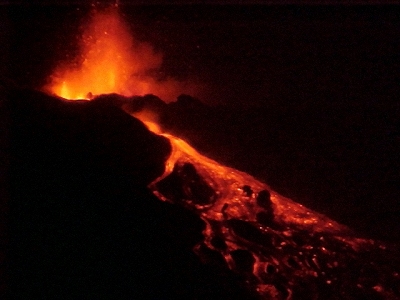
Mt. Etna – Photo Journal of the Eruptions of 2001
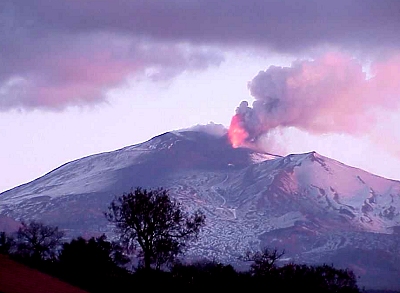
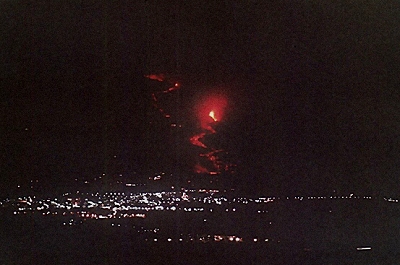
Mt. Etna is a truly massive volcano with a height of 10,910 (and growing) feet covering approximately 460 square miles. It is almost constantly in a state of eruption. However, in the summer of 2001 the activity ratcheted up a notch adding nearly 300 feet to the mountain top and threatening the town of Nicolosi (right).
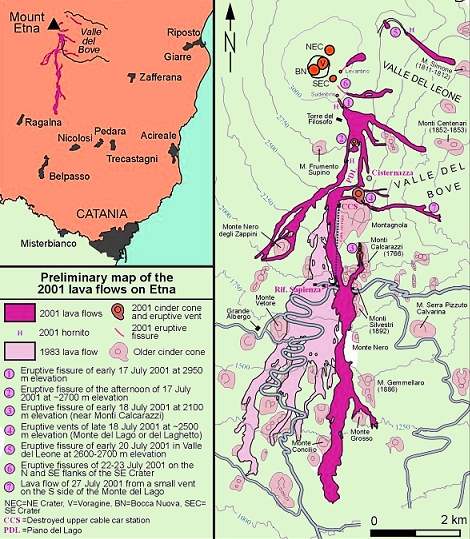
The map below shows the pyroclastic flows associated with the July-August eruption of Mt. Etna. On the pages that follow I will share with you some images I collected at the time of the eruption.
The first known non-indigenous people to settle in Sicily were the Sikels. Around BC 1400 these people migrated from the Italian mainland and coexisted peacefully with the Sicans. It was around the same time that the Elymi people also began to settle on the island.
Around BC 1000, the Phoenicians began to settle along the coasts of Sicily. They, too, peacefully coexisted with the Sicans, Sikels and Elymi. The earliest literary mention of Sicily’s history and its early inhabitants can be found in Homer’s The Odyssey – expressed as the land of the Cyclopes, the land of the Laestrygonians and the island of Aeolus.
Sicily’s history took a dramatic turn when the Greeks began to colonize the island, 300 years later.
Around BC 735, the Greeks established Naxos – between modern day Catania and Taormina – as an expansion of Magna Graecia (the Greek colonies in Southern Italy). It was the first Greek colony on the island. The Greeks also established Syracuse around the same time on the southeastern coast of the island. This colonization marked the birth of one of the most influential eras in Sicilian history. As the old Sicilian civilizations were virtually absorbed into Hellenistic culture, the Greeks quickly spread their empire throughout Sicily. During this era, they built the Valley of the Temples, located in Agrigento. Most of this temple complex still stands today and is regarded as one of the most impressive temple complexes outside of Greece.
Roman control of Sicily lasted almost 700 years. In AD 440, the Vandals invaded the island and asserted control. For the next 600 years, Sicily was controlled by the Vandals, followed by the Ostrogoths, the Byzantines and the Arabs.
Beginning in AD 1060, however, the Normans took control of Sicily. The Norman Era spawned many artistic achievements, due to the Norman’s eclectic culture. Modern Sicily is still enriched by Norman architecture in almost every city center on the island.
The Normans ruled Sicily for the next century, until the heiress to the last Norman Emperor, Constance, married Holy Roman Emperor Henry VI of Swabia in AD 1194. Swabian control didn’t last long, however. When the last Swabian ruler died, his successors were weak and ultimately gave way to papal control.
In AD 1266, Pope Innocent IV crowned Prince Charles of Anjou as king of Sicily. Charles was not well accepted, though, as he imposed high taxes and practiced religious intolerance in a land of religious diversity. This led to an uprising of the Sicilian people in AD 1282 called the War of the Sicilian Vespers – as it began during evening vespers on Easter Monday. This resulted in the killing of most of the French population in Sicily. With no leader, the Sicilian people turned to Peter III of Aragon for support and direction.
For the next 600 years, the history of Sicily was dominated by the Aragons and the Spanish.
The Recent History of Sicily
It was in 1860 that the Expedition of the Thousand was led by Giuseppe Garibaldi during the Risorgimento, or Italian Unification. A year later, Sicily was annexed by Italy.