
My Visit to the Leaning Tower of Pisa
 For visitors to Italy the Leaning Tower of Pisa is practically a mandatory stop. This is a well known and generally accepted fact. This has a great affect the local economy of Pisa but, for the visitor this lends to a very touristy vibe. The day of our visit there was a carnival-like atmosphere just outside the Campo dei Miracoli. Vendors were selling items in open air stalls with offerings to suit every taste. There were candies, leather goods, hats, sunglasses, Pisa tourist maps, Pisa guide books, craftsmen, and artists of all forms. However I will never forget the roaming guys with the knock-off wristwatches. They had them attached to felt covered boards that had cheap sun glasses attached to a second piece of felt covering the time pieces. These guys were shady – always looking over their shoulders – and, very, very persistent. They had Gucci, Prada, Citizen, Rolex and many others at very, reasonable prices. They would not leave us alone. It was like when a dog really, really likes your leg. We couldn’t shake them off. I noted that they did not have any Bulova in their offerings. So, I told them that only Bulova would do. I wanted nothing else. This seemed to work. They said they could come up with Bulova… Off they went into the Pisan crowd to find the goods. They returned to our table at the caffe’ bar where we were admiring a lovely view of the leaning tower of Pisa, after about twenty minutes. They offered steep discounts to the already ridiculous prices. I asked if they had found any Bulovas. They had not. So, I stood firm. I insisted on my brand of choice and sent them off to find their next victim.
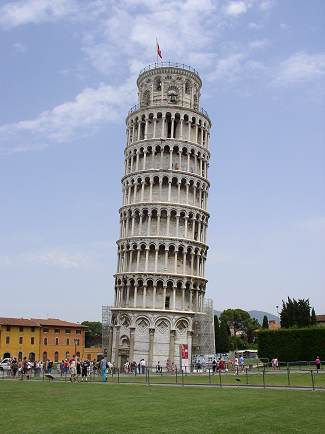 Here is the timeline for the Tower:
| 1173 | Construction of the Leaning Tower of Pisa begins (Though it was not actually leaning at this point). |
| 1178 | Work on the Tower stops with only three tiers completed |
| 1272 | Work resumes on the Tower of Pisa |
| 1278 | Construction of the Tower comes to a halt after reaching the 7th tier |
| 1298 | The Tilt of the tower is first observed and the Leaning Tower of Pisa is seen as a tragically botched construction job. A commission is formed to investigate the cause and effect a remedy. At this point no one knows that the unstable foundation of the Leaning Tower of Pisa will be the solid foundation for a future tourist economy. |
| 1370 | The Leaning Tower of Pisa is officially completed |
| 1589 | Galileo Galilei conducts his famous experiments, dropping objects from the Leaning Tower of Pisa. |
| 1902 | The bell tower in Venice’s Piazza S. Marco collapses generating fresh concern over the notable instability of the (now famously) Leaning Tower of Pisa |
| 1990 | The Italian government closes the Leaning Tower of Pisa due to concerns for public safety. |
| 1999 | Soil extraction is performed. This proves to be the definitive solution to the Tower of Pisa’s stability |
| 2001 | Pisa celebrates the restoration of the Leaning Tower. |
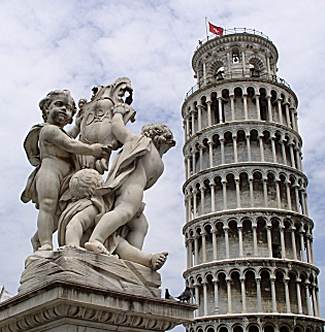
The Campo dei Miracoli is filled with splendid art with the iconic Tower as a backdrop
A photo of the Leaning Tower of Pisa taken from the angle that shows the maximum tilt of the tower. The Campo dei Miracoli is filled with splendid art with the iconic Tower as a backdropThe Cathedral (Duomo) and the Leaning Tower of Pisa in relation to the straight, vertical walls of the Cathedral. Credit for information on this tour:Shrady, N. (2003) Tilt. Simon & Shuster. NY, NY, USA.Machiavelli, F., Martin, S., Townsend, H., Tyrrell, N (1996). Eyewitness Travel Guides: Italy. DK Publishing. NY, NY, USA.Sarti, R. (2004). Italy – A Reference Guide from the Renaissance to the Present. Facts on File Inc.. NY, NY, USA.field of miracles and things to see and do in pisa